Together with the University of Groningen, we’re researching how mienskip (community) projects work. How a small idea in a village can grow into something big. How art and culture bring people together, and how that connection lasts once the project…
9 May 2025
Together with the University of Groningen, we’re researching how mienskip (community) projects work. How a small idea in a village can grow into something big. How art and culture bring people together, and how that connection lasts once the project is over. Researcher Carmen van Bruggen therefore looks not only at what happens during activities, but also at what changes within a mienskip. Her research consists of four parts. In the third part, she follows one Bloeiweek (Blooming Week) of Fryslân Bloeit with three measurement moments: before, during and after. This shows how connection forms, grows and lasts.
Research into the Bloeiweek of Kollumersweach and Feankleaster, 9 to 18 May.
One sub-project of the PhD research is following the Bloeiweek in Kollumersweach and Feankleaster. This research project is special because it’s a long-term study that looks at what the Bloeiweek brings about at different points in time — a so-called longitudinal study.
Many studies only have one measurement moment, often right after a project. That provides useful insights, but doesn’t always show which changes were really set in motion by the project.
That’s why we look beforehand, during and further afterwards. A lot often already happens during preparation. Organisers and volunteers meet new people. They visit different places. They try something they haven’t done before. A lot also happens afterwards. A performance or festival stays a topic of conversation. Trying a sport or yoga session once can lead to a new hobby or membership.
With this broader view, we hope to better see what the Bloeiweek sets in motion within the mienskip of Kollumersweach and Feankleaster, and what role art and culture play in that.
Research design
In February 2025, door-to-door surveys were distributed in Kollumersweach and Feankleaster. This was the first measurement moment. The second survey follows a week after the Bloeiweek and focuses on participants’ experiences. Did someone come alone or together? Were the activities surprising or familiar? Did they take place in known or unknown locations? Two years after the Bloeiweek, a third survey follows for the whole village. This looks at whether the Bloeiweek changed, strengthened or set something in motion.
Besides the surveys, observations are also made on-site during activities. This always happens with the permission of those involved. All data is processed anonymously.
What we want to learn
Many studies only have one measurement moment, often right after a project. That provides useful insights, but doesn’t always show which changes were really set in motion by the project.
That’s why we look beforehand, during and further afterwards. A lot often already happens during preparation. Organisers and volunteers meet new people. They visit different places. They try something they haven’t done before. Also afterwards a lot happens. A performance or festival stays a topic of conversation. Trying a sport or yoga session once can lead to a new hobby or membership.
With this broader view, we hope to better see what the Bloeiweek sets in motion within the mienskip of Kollumersweach and Feankleaster, and what role art and culture play in that.
First insights
Because gathering and processing all the information takes time, we’re already sharing some first insights along the way. The survey we distributed in the villages in February 2025 received 357 responses. 58 of these came by letter. Together, these responses give a first sketch of the mienskip of Kollumersweach Feankleaster.
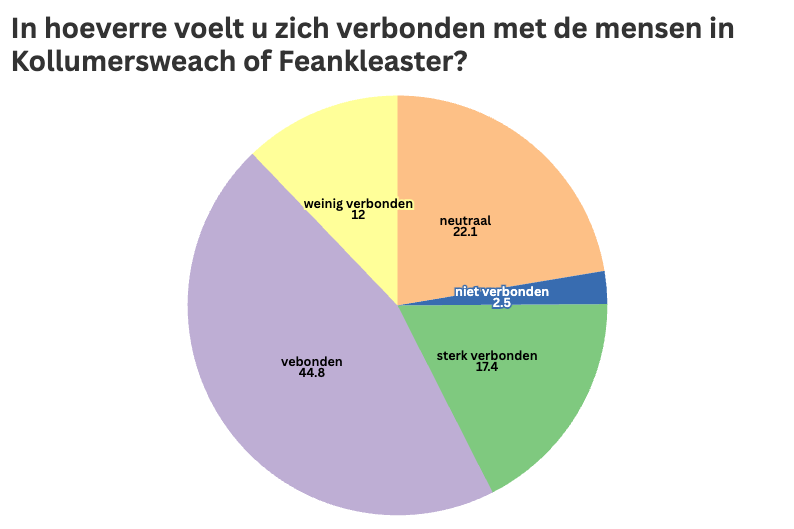
We asked how connected people feel to other villagers.
17 percent feel strongly connected
45 percent feel connected
22 percent are neutral
12 percent feel little connection
3 percent feel no connection
This graph shows how strongly residents feel connected to other villagers. The majority feel connected or strongly connected.
The answers show that clubs, associations and the church play an important role in village life.
37 percent are active at a sports club (as a member, volunteer, staff member or otherwise)
55 percent are active in a church community
11 percent are active at a cultural association
6 percent are active at the business association
51 percent help out with activities in the village
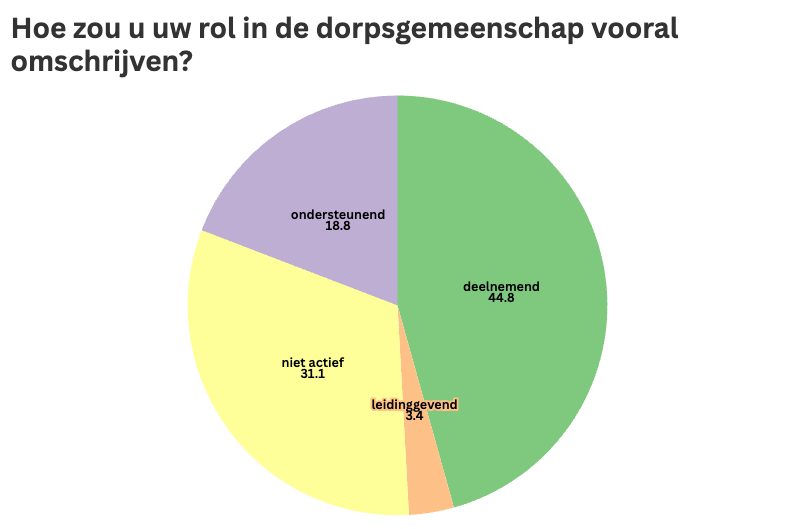
This graph shows how residents describe their role in the village community. Most see themselves as a participant or in a supporting role.
How people see their role
69 percent are active in the village community
45 percent of them mainly call themselves a participant
19 percent see themselves as supporting
3 percent see themselves as leading
What we hear from people who are less active Some don’t feel a need to change this. Commonly mentioned reasons are old age, health issues, or being busy with work or a young family. Some live happily in the village but have their social life elsewhere. A few don’t feel a connection to the village. A few people say they feel excluded because they came from outside. Someone else says integrating actually went well thanks to helpful neighbours.
Wishes to get more involved There are also residents who would like to become more active. They mention, for example, the wish to help out at the cemetery, the village hall, the school or the church. Others would like to make more friends and acquaintances in the village. Some people want to do more with music and creativity. Others want to work towards more connection and less pigeonholing.
Feedback
We’re happy to present the final results in the village afterwards. Everyone is very welcome to attend. We also share the outcomes through a scientific publication and local news reports. We always do this anonymously. We don’t mention any names.
Contact
Do you have questions about the research, or would you like to stay up to date?
Wij gebruiken cookies die ons helpen te begrijpen wat je het meest waardeert in de verhalen op ons web-universum. Wij gebruiken alleen de essentiële cookies om onze website soepel te laten functioneren. Privacy is belangrijk voor ons. We zorgen ervoor dat jouw gegevens veilig zijn en respecteren je keuze.
Functional
Always active
The technical storage or access is strictly necessary for the legitimate purpose of enabling the use of a specific service explicitly requested by the subscriber or user, or for the sole purpose of carrying out the transmission of a communication over an electronic communications network.
Preferences
The technical storage or access is necessary for the legitimate purpose of storing preferences not requested by the subscriber or user.
Statistics
The technical storage or access used exclusively for statistical purposes.The technical storage or access that is used exclusively for anonymous statistical purposes. Without a summons, voluntary compliance by your Internet Service Provider, or additional records from a third party, information that is stored or retrieved for this purpose usually cannot be used to identify you.
Marketing
The technical storage or access is required to create user profiles for the sending of advertising, or to track the user on a site or across various sites for similar marketing purposes.