Eveline van der Pas made six frames for the Maakruimte at Arcadia. She is an artist and teacher at the Kunstacademie Friesland. In her work, she explores the life we often don’t see, but which is essential: life in the soil. For Arcadia she made frames of her own, and she also worked with the participants of her mienskip (community) workshop GRÛNRÊDERS on the opening day at the Oldehoofsterkerkhof.
The GRÛNRÊDERS workshop
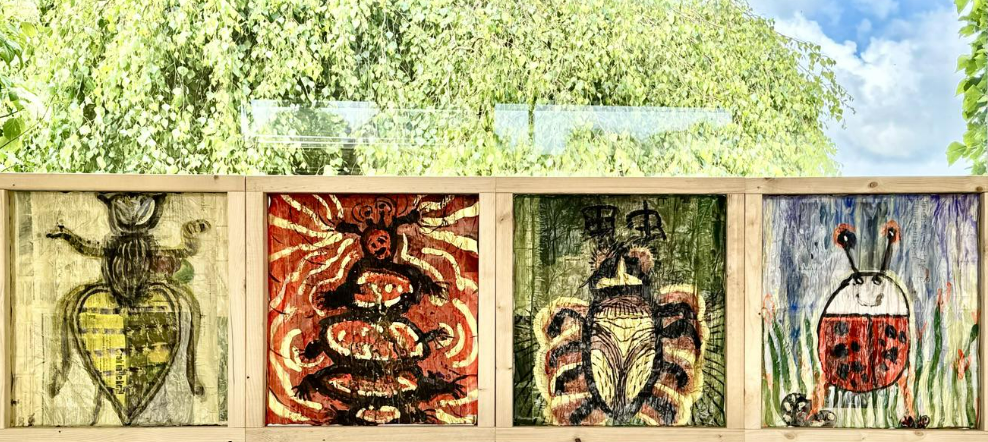
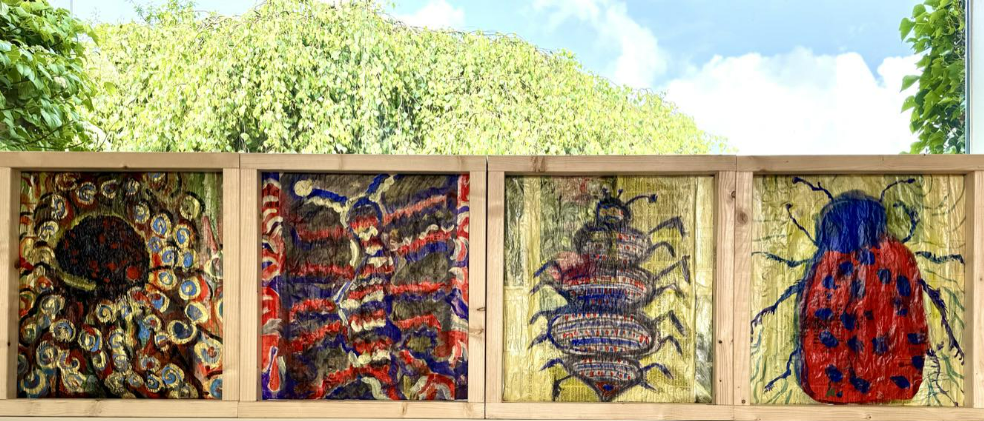
The workshop was open to everyone – young and old joined in. With Japanese brushes and ink, participants painted on opened-up newspapers. That way, life in the soil literally overgrew the news. Eveline asked them: “What does soil mean to you?”
The answers were very different:
- “Soil is the foundation of my business.”
- “Soil grounds me, especially outside in nature.”
- “Searching for worms to go fishing.”
- “Soil gives us food, for us and for the animals.”
- “Soil gives me a basic feeling of coming home. I get happy when I lie in the grass and smell the salty air of Waadhoeke.”
- “Once I dug clay out of the ground and made a bowl from it.”
- But also: “Soil makes my hands dirty” and “Those little creatures in the soil, ants, worms and moles – yuck!”
Eveline replied: “Did you know that it’s exactly those ants, worms and moles that help keep an ecosystem healthy?” During the workshop, people shared, told stories and laughed a lot. Stories came by about dirty hands, special insects, and children who said they carry spiders and ants out of the house “because they feel sorry for them”.
Did you know that one cubic centimetre of healthy soil contains more living organisms than there are people on Earth? And that without those living organisms, there would be no life for us? Fun facts like these, and drawings of centipedes or fungal threads, sparked the participants’ imagination.
Everyone got the same assignment: “Make the biggest living creature you can on this newspaper. Show how it moves, how it works the soil, and paint the ground around it too. Make sure the news is overgrown with life.” People worked, laughed and shared with great joy.
The frames from the workshop
Afterwards, Eveline made four frames from the work created in the workshop. She added legs, soil layers and colours to the paintings, repaired small tears and sometimes glued drawings together, so the images could be seen from both sides. That way, the participants’ stories became part of the Maakruimte.
Her own frames
In her own artwork, Eveline shows how full of life healthy soil is – from fungi and bacteria to worms and roots. For Arcadia she made two landscape frames that you can look at from both sides.
Eveline van der Pas marvels at the life we can’t see with the naked eye. She shows that healthy soil is full of life. She makes small life visible: fungi, bacteria, worms, roots and other soil life.
In the two frames she made for the Maakruimte, she shows the fragile ecosystem in two Waadhoeke landscapes, which you can view from two sides.
POLLARD WILLOW – VILLAGE IN THE DISTANCE IN WAADHOEKE
On Japanese paper (in the photos on the left), Eveline van der Pas painted this Waadhoeke landscape with inks, Japanese brushes and a reed pen. You see a pollard willow with an extensive root system in the ground below the ditch. You wouldn’t see this in real life: Eveline imagined how life in the soil carries on. That makes it just as important as everything above ground in her landscapes. In the root system, you can see life in the soil.
Did you know that a tree’s root system is just as big as the crown that rises above the ground? Of course, this doesn’t apply to pollard willows, because in the ground they can grow freely without pruning and reach out to other trees.
The water of the ditch reflects the clouds. Without clean water, there is no life, either above or below the ground. It is a means of transport for the substances exchanged by vegetation, by fungi and by living organisms in the soil. You see a landscape like this a lot in Waadhoeke.
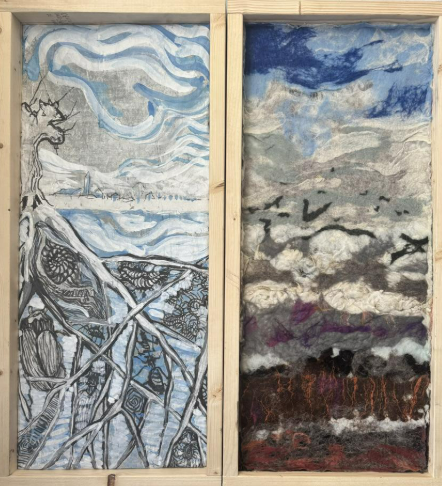
In both left-hand images, you can see that the back of the work is just as clear as the front. That’s because of the light and the thin paper. It is painted on one side only.
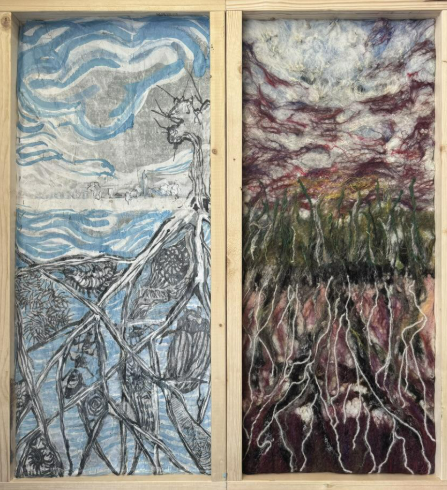
WADDEN LAND OF WAADHOEKE
When you walk along the dyke near Zwarte Haan, you see different colours, clouds and light on the water every time. Sometimes bright red plants against a bright blue sky, sometimes the horizon disappears in haze or mist. Eveline van der Pas is fascinated by this landscape with the Wadden Sea in Waadhoeke. She has translated Wadden landscapes into textile materials before. In both right-hand images, she used raw wool from Waadhoeke, alongside silk thread and dyed wool. The work is finished on both sides and held together by felting the wool. Light shines through it, yet you experience both sides as different Wadden landscapes. The top side, in daytime with wind and clouds, shows salty vegetation. The bottom side, in the evening with a sunset, shows a cross-section under the ground, full of roots and different soil layers.
What do the six artists of Myn Grûn do?
With Myn Grûn, we bring art, music, nature and mienskip together in the municipality of Waadhoeke. Together with residents and artists, we work on artworks rooted in local stories, traditions and it lânskip (the landscape). So what makes Myn Grûn so special? It’s the encounter. Between art and people. Between past and present. Between above and below ground. Between what we see and what we only learn to see when we pause for a moment. And then something happens. Art lets us experience things differently. When we work on something together, we start talking with each other. About our village. About our land. About ourselves.
The municipality of Waadhoeke plays an important role in this. Thanks to its contribution to Arcadia 2025, all these activities could be offered for free. That is a powerful gesture: showing that culture isn’t only for big stages or museums. It belongs in the farmyard, in the village hall or in the middle of a meadow. Art belongs in life. In the mienskip.
Eveline van der Pas is part of the GRÛN group, made up of six artists. Betty van der Kamp, Liesbeth Daale, Joke Lunsing, Doet Boersma and Foppe Boersma are also part of the GRÛN group.